Publication History
Homesteads & Happiness Pages.
Click Item Number in Blue (Top of Page) for Details
Insert content here
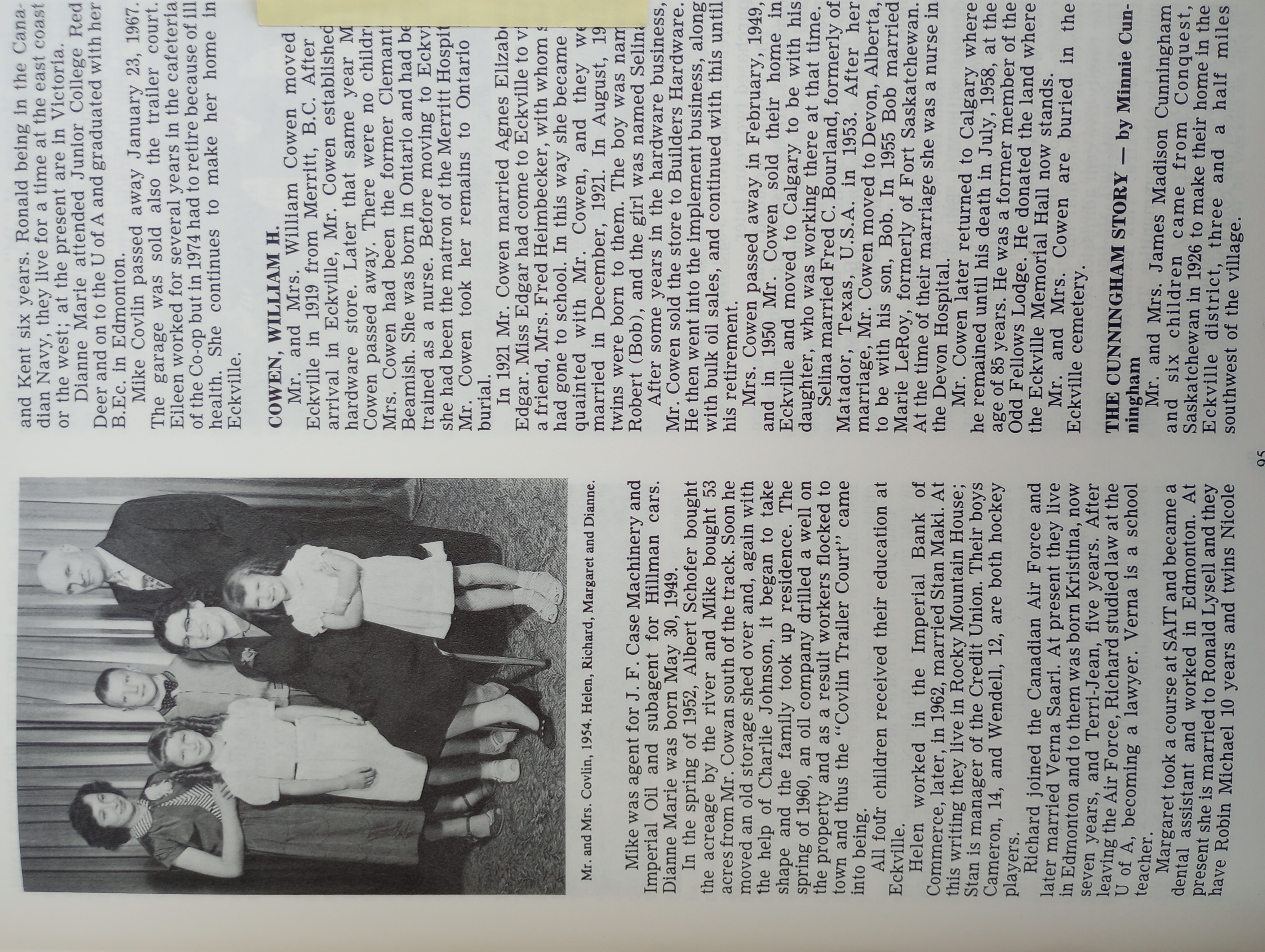
The sample text below here was scanned in PDF format from a page of Homesteads and Happiness.
It is an image which retains its proportions regardless of what device it is displayed on.
When you shrink or expand this image , everything expands or shrinks with it, both pictures and text. This becomes problematic when the image is viewed by a mix of screen sizes. What may be comfortable on a desktop computer or a large laptop screen, would require manual manipulation when viewed on a smaller tablet or a phone.
A Fixed Image ratio (pdf) file.
Contrasted to:
A dynamic text based article below.
The sample text below here is the same PDF page of Homesteads and Happiness. It was then converted to plain text using PDF & OCR conversion software. The picture was inserted on its own. This open format technique allows the text to adapt to whatever screen size is being used to view the document. Images will adjust to the screen size and they 'float' with the text to adapt to the display size being used. If you are viewing this on a larger windows screen, you can click and hold on the right boarder of your window and move it to the left. Note what happens to the images and the print while you are doing this. Also do the same while you are viewing the fixed image. Not the differences. Or, you can compare what you see on a large screen with what you see when you view these articles on your phone.
There was tape on the right side of the original document when it was scanned. The tape hid some of the print from the OCR converter, so there are some missing characters in the text that I haven't taken the time to correct. Because it is editable text, It just requires simple text editing to correct it.
BK
COVLIN, MIKE
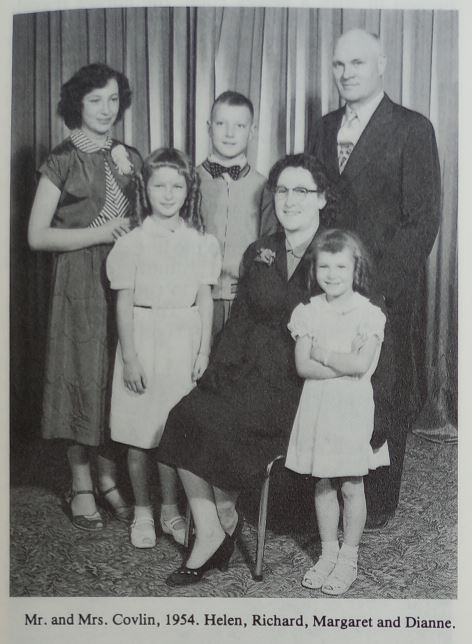
Mike was agent for j. F. Case Machinery and Imperial Oil and subagent for Hillman cars. Dianne Marie was born May 30, 1949.
In the spring of 1952, Albert Schofer bought the acreage by the river and Mike bought 53 acres from Mr. Cowan south of the track. Soon he moved an old storage shed over and, again with the help of Charlie Johnson, it began to take shape and the family took up residence. The spring of 1960, an oil company drilled a well on the property and as a result workers flocked to town and thus the "Covlin Trailer Court" came
into being.
All four children received their education at Eckville.
Helen worked in the Imperial Bank of Commerce, later, in 1962, married Stan Maki. At this writing they live in Rocky Mountain House; Stan is manager of the Credit Union. Their boys Cameron, 14, and Wendell, 12, are both hockey Players.
Richard joined the Canadian Air Force and later married Verna Saari. At present they live in Edmonton and to them was born Kristina, now seven years, and Terri-jean, five years. After leaving the Air Force, Richard studied law at the U of A, becoming a lawyer. Verna is a school teacher.
Margaret took a course at SAIT and became a dental assistant and worked in Edmonton. At Present she is married to Ronald Lysell and they have Robin Michael 10 years and twins Nicole and Kent six years. Ronald being in the Cana-dian Navy, they live for a time at the east coast or the west; at the present are In Victoria.
Dianne Marie attended junior College Red Deer and on to the U of A and graduated with her B.Ec. in Edmonton.
Mike Covlin passed away January 23, 1967. The garage was sold also the trailer court. Eileen worked for several years in the cafeteria of the Co-op but in 1974 had to retire because of ill health. She continues to make her home in Eckville.
COWEN, WILLIAM H. t
Mr. and Mrs. William Cowen moved Eckville in 1919 from Merritt, B.C. After arrival in Eckville, Mr. Cowen establlsheC hardware store. Later that same year M Cowen passed away. There were no childr Mrs. Cowen had been the former Clemant Beamish. She was born in Ontario and had be trained as a nurse. Before moving to Eckv she had been the matron of the Merritt Hospi
Mr. Cowen took her remains to Ontario burial.
In 1921 Mr. Cowen married Agnes Elizab Edgar. Miss Edgar had come to Eckville to v a friend, Mrs. Fred Heimbecker, with whom s had gone to school. In this way she became ( quainted with Mr. Cowen, and they \n( married in December, 1921. In August, 19 twins were born to them. The boy was narr, Robert (Bob), and the girl was named Selina
After some years in the hardware business, Mr. Cowen sold the store to Builders Hardware. He then went into the implement business, along with bulk oil sales, and continued with this until his retirement.
Mrs. Cowen passed away in February, 1949, and in 1950 Mr. Cowen sold their home in Eckville and moved to Calgary to be with his daughter, who was working there at that time.
Selina married Fred C. Bourland, formerly of Matador, Texas, U.S.A. in 1953. After her marriage, Mr. Cowen moved to Devon, Alberta, to be with his son, Bob. In 1955 Bob married Marie LeRoy, formerly of Fort Saskatchewan. At the time of their marriage she was a nurse in the Devon Hospital.
Mr. Cowen later returned to Calgary where he remained until his death in July, 1958, at the age of 85 years. He was a former member of the Odd Fellows Lodge. He donated the land where the Eckville Memorial Hall now stands.
Mr. and Mrs. Cowen are buried in the Eckville cemetery.
The CUNNINGHAM STORY — by Minnie Cunningham
Mr. and Mrs. James Madison Cunningham and six children came from Conquest, Saskatchewan in 1926 to make their home in the Eckville district, three and a half miles southwest of the village.
Dynamic Text Below:
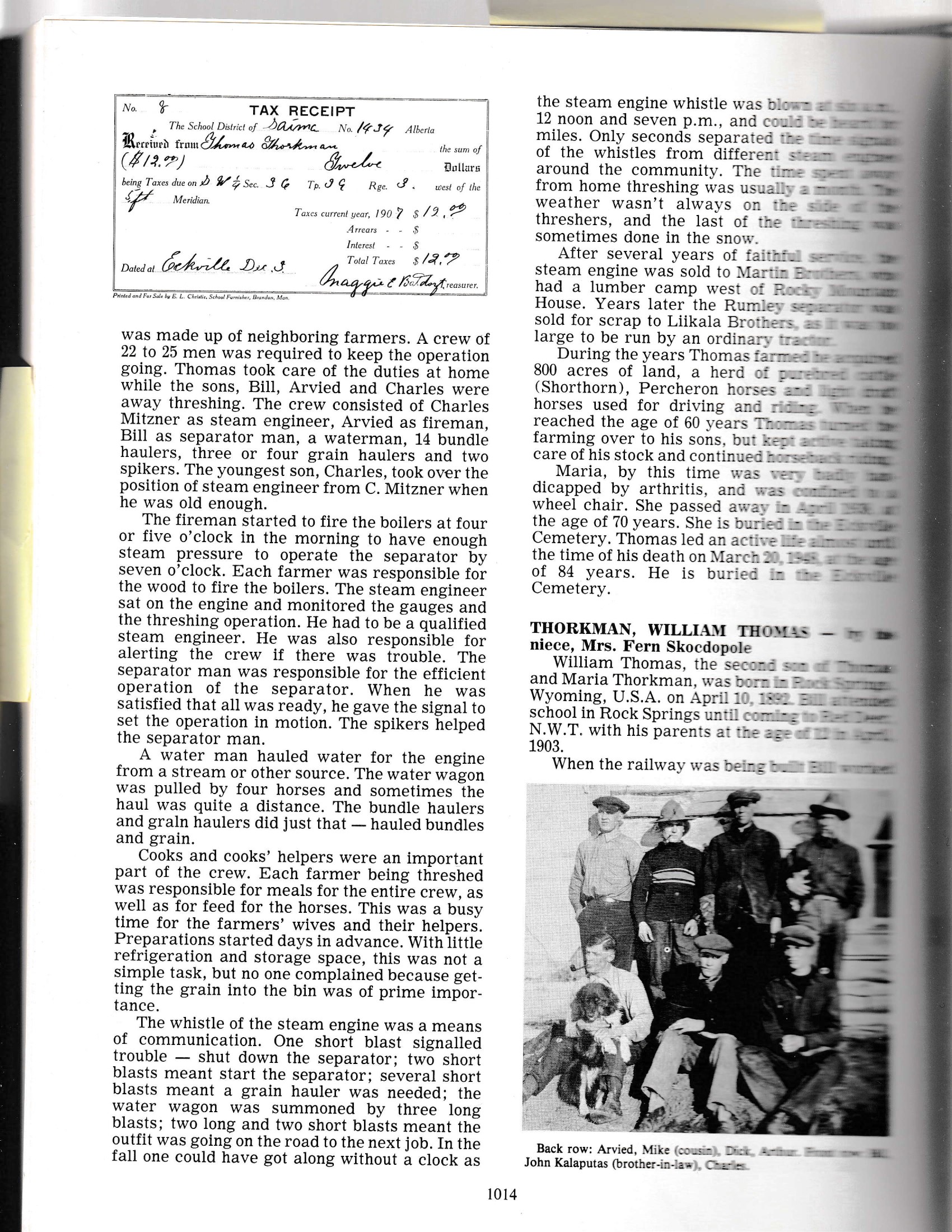
The picture of a threshing crew was inserted to help illustrate the concept. It also illustrated the ease of editing a text based wiki-like content.
Quote
"was made up of neighboring farmers. A crew of 22 to 25 men was required to keep the operation going. Thomas took care of the duties at home while the sons, Bill, Arvied and Charles were away threshing. The crew consisted of Charles Mitzner as steam engineer, Arrived as fireman, Bill as separator man, a waterman, 14 bundle haulers, three or four grain haulers and two spikers. The youngest son, Charles, took over the position of steam engineer from C. Mitzner when he was old enough.
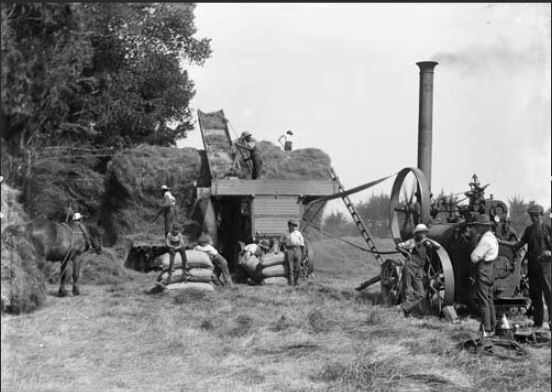
The fireman started to fire the boilers at four or five o'clock in the morning to have enough steam pressure to operate the separator by seven o'clock. Each farmer was responsible for the wood to fire the boilers. The steam engineer sat on the engine and monitored the gauges and the threshing operation. He had to be a qualified steam engineer. He was also responsible for alerting the crew if there was trouble. The separator man was responsible for the efficient operation of the separator. When he was satisfied that all was ready, he gave the signal to set the operation in motion. The spikers helped the separator man.
A water man hauled water for the engine from a stream or other source. The water wagon was pulled by four horses and sometimes the haul was quite a distance. The bundle haulers and grain haulers did just that — hauled bundles and grain."
End quote.
Note that the image of the page below retains its ratio (and relative print size) when it is viewed on a larger or smaller screen. This means that the print size can be unreadable on a small screen unless the image is stretched to make it larger. The stretching of the image then means that you must move the screen around to follow the print. Compare this article on your desktop, laptop and your phone to see the adjustments that are automatically made to the free text format vs the fixed page image..
The print above remains at a readable size while the words per line adjust to maintain the readable size. The concept isn't what a hardcover book reader is used to but it is far more adaptable for on line reading. Another major advantage with the information being stored as text is the ability to easily insert or edit existing information without the challenges inherent with the inflexibility of a traditional page format. The adaptation of the image and print formatting is inherent with the technique.
Fixed Format Image.